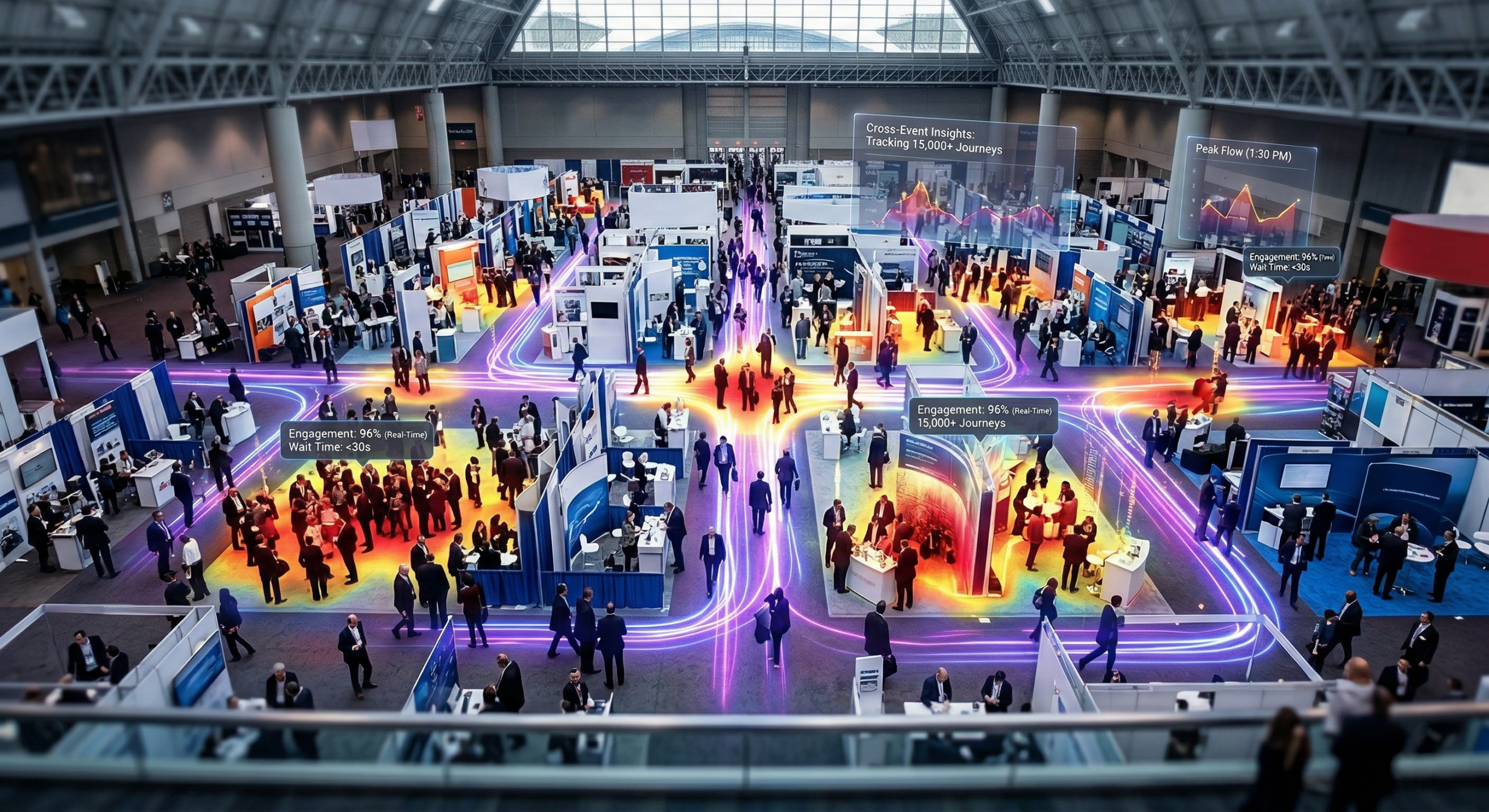
For exhibitors, trade shows are one of the most complex and high-stakes marketing investments they make.
At the same time, every successful exhibit depends on strong coordination across logistics, lead capture, staffing, and follow-up. In other words, exhibit management is not one task. Instead, it is a system of connected steps, where small issues can quickly create bigger problems. For example, research shows that even lead retrieval includes capturing contact data, scoring leads, tracking engagement, and sending that data into other systems for following up (ExpoPlatform).
As a result, when coordination fails, performance drops. Teams lose leads, follow-up slows down, and ROI becomes harder to prove.
This is where AI starts to play a role. Specifically, it helps teams manage this process more effectively. It reduces manual work and supports clearer, data based decisions across logistics, engagement, and measurement. In fact, industry data shows that teams are already using AI for tasks like attendee tracking, matchmaking, and logistics management (Associations Now).
Ultimately, this shift is less about new technology and more about gaining control. Teams that apply AI to operations, not just marketing, can reduce complexity and improve results.




Key Takeaways
- Exhibit management is a multi-step operational system, not a single activity
- AI reduces complexity across logistics, coordination, and reporting
- Trade show operations benefit most from real-time data and automation
- AI improves lead capture, qualification, and follow-up workflows
- Most organizations are still early in integrating AI into event operations
How Are Exhibitors Currently Using AI?
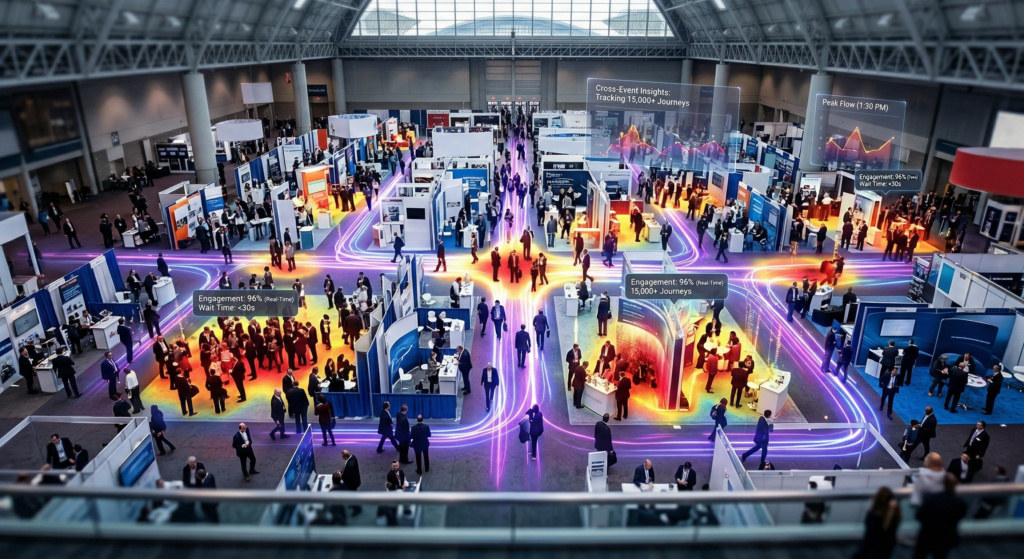
AI adoption in event planning is growing, but most use cases are still tactical.
Today, about half of organizations use AI somewhere in the event planning process. However, most teams still focus on content and marketing instead of operations (PCMA). As a result, current use cases tend to fall into a few clear areas:
- Content and Campaign Support
Teams widely use AI to generate marketing content, emails, and event messaging. - Reporting and Summarization
AI tools help summarize post-event reports, survey data, and performance insights. - Data Analysis and Personalization
Some teams are using AI to improve attendee personalization and analyze engagement patterns (PCMA).
These use cases improve efficiency, but they do not yet address the operational complexity of exhibit management.
Where AI Has the Greatest Impact in Exhibit Management
The most meaningful impact of AI is in execution and operations.
Real-Time Lead Capture and Qualification
AI-powered lead retrieval systems allow exhibitors to capture detailed information during interactions, including lead type, product interest, engagement notes, and qualification scores (ExpoPlatform).
Likewise, some systems enable instant lead scoring and enrichment, allowing teams to prioritize opportunities while the event is still in progress (Leadature).
Attendee Engagement and Matching
AI can recommend meetings between attendees and exhibitors based on shared interests and behavior, increasing the likelihood of meaningful connections (Leadature).
Booth Traffic and Behavior Analysis
AI tools can measure booth traffic patterns and engagement in real time, helping teams adjust staffing, demos, and interactions (Leadature).
Trade Show Logistics and Coordination
AI improves coordination across vendors, shipping, and installation by providing a better view into timelines and dependencies.
These capabilities shift exhibit management from reactive coordination to more proactive decision-making.
How AI Improves Trade Show Analytics and ROI Measurement
Measuring trade show ROI has often been inconsistent and incomplete.
Today, best practices focus on clear KPIs such as lead volume, engagement, and meetings booked. At the same time, teams must track total event cost, including booth build, logistics, staffing, and promotions (InEvent).
With this in mind, AI strengthens this process in several ways:
- Improving Lead Qualification
Lead data can include badge scans, notes, and must-have details, which makes it easier to focus on the right people (InEvent). - Improving Lead Capture and Follow-Up
AI-supported processes help structure and standardize lead capture on-site, which means faster, more consistent follow-up after the event (InEvent). - Expanding ROI Measurement
Modern ways to measure ROI include not only direct sales, but also influenced pipeline, repeat business, and long-term customer value (InEvent).
Overall, AI makes these insights easier to access by linking data across systems.
Why Most Exhibit Teams Aren’t Ready for AI
Despite growing adoption, the industry remains early in its use of AI.
Research shows that while many organizations are testing out AI, a significant portion do not yet see an immediate need to integrate it into planning processes. At the same time, most teams are actively seeking training, use cases, and guidance on how to apply AI effectively (PCMA).
This highlights a key challenge:
The barrier is not access to technology, but the ability to integrate AI into existing workflows and operational systems.
Data, Privacy, and Operational Considerations
As AI becomes more common in events, data management becomes more important.
For this reason, best practices recommend clearly stating what data is collected, how it is used, and who can access it. In addition, attendees should be able to control how their data is used through clear consent options. Simultaneously, tools like facial recognition and location tracking raise new concerns. Therefore, teams must ensure clarity, accountability, and human monitoring (Gevme).
These considerations are especially important for exhibitors working across different regions with different regulations.
The Future of AI-Powered Exhibit Management
The future of AI in exhibit management is not just a theory. It is already emerging in practical ways.
Industry trends show a shift toward real-time behavioral learning and unified event data, rather than relying on forecasts or simulations (Event Tech Live).
Near-term developments include:
- Real-time recommendations based on attendee behavior
- Cross-event understanding to improve targeting and engagement
- More advanced matches between exhibitors and attendees
Importantly, current platforms are not yet capable of fully predictive audience simulation, which reinforces the need for a realistic view of AI’s role in event planning (Event Tech Live).
What This Means for Exhibitors
The opportunity is not simply adopting AI tools.
Instead, it is about refining how teams run exhibit programs.
For exhibitors, this means:
- Reducing operational complexity across events
- Improving coordination between partners and vendors
- Increasing sight into logistics and timelines
- Connecting event data to broader marketing and sales systems
As a result, teams that focus on these areas can run events more efficiently and show clearer ROI.



FAQ
How is AI used in exhibit management?
AI is used to automate lead capture, improve logistics coordination, enhance attendee engagement, and strengthen performance analytics. It also supports real-time decision-making during events, such as prioritizing leads and adjusting staffing based on booth traffic.
Can AI improve trade show logistics?
Yes. AI improves logistics by providing better visibility into timelines, identifying potential delays, coordinating vendors, and optimizing shipping and installation schedules across multiple partners.
What are the benefits of AI for event management?
AI reduces operational complexity, improves efficiency, enhances data-driven decision-making, and supports better ROI measurement. It also enables faster follow-up and more accurate lead prioritization.
What part of exhibit management benefits most from AI?
The greatest impact is in operations, including logistics coordination, lead capture, and real-time analytics. These areas involve the most complexity and benefit the most from automation and predictive insights.
Is AI replacing trade show teams?
No. AI is augmenting teams, not replacing them. It reduces manual work and improves visibility, allowing teams to focus on strategy, engagement, and execution rather than coordination tasks.
How should exhibitors start using AI for trade shows?
Exhibitors should start by focusing on operational improvements, such as standardizing lead capture, improving follow-up processes, and increasing visibility into logistics and timelines. These areas provide the fastest and most measurable impact.
Do I need a global exhibit partner to implement AI in exhibit management?
Not necessarily, but coordination becomes significantly easier when logistics, fabrication, and program management are connected. For exhibitors running multi-show or multi-region programs, working with a partner like Absolute Exhibits that integrates exhibit management services, trade show logistics, and global program coordination can reduce fragmentation and improve execution consistency. Data workflows can be layered through your existing CRM and event tech stack or supported by specialized partners.
What should I look for in an exhibit management provider?
Look for capabilities that support strong execution and coordination. This includes experience with trade show logistics, in-house or tightly coordinated fabrication, and structured exhibit management processes that reduce complexity across events. Providers that can align multiple vendors, timelines, and on-site execution while maintaining consistency across shows are better positioned to support reliable outcomes and reduce risk.
Conclusion
AI is transforming how teams execute exhibit management and trade show operations.
The most significant impact is not in marketing or content creation, but in operations, where complexity has historically limited efficiency and ability to scale.
For exhibitors, the advantage will come from using AI to improve coordination, reduce risk, and make better decisions across the entire event lifecycle.
Sources and Research References
- ExpoPlatform (n.d.), Trade Show Lead Retrieval: Capture More and Increase ROI
- Associations Now (2024), Report: Meeting Planners Expanding AI Use in Events
- PCMA (2024), Study Identifies Missed Opportunities to Use AI in Event Planning
- Leadature (2024), AI for Events: Practical Tools and Use Cases for Events
- InEvent (2024), How to Calculate Trade Show ROI
- Event Tech Live (2024), AI’s Digital Doppelgängers Promise to Predict Your Attendees — But Can They Deliver?
- Gevme (2024), AI Ethics in Event Management: Balancing Innovation with Privacy