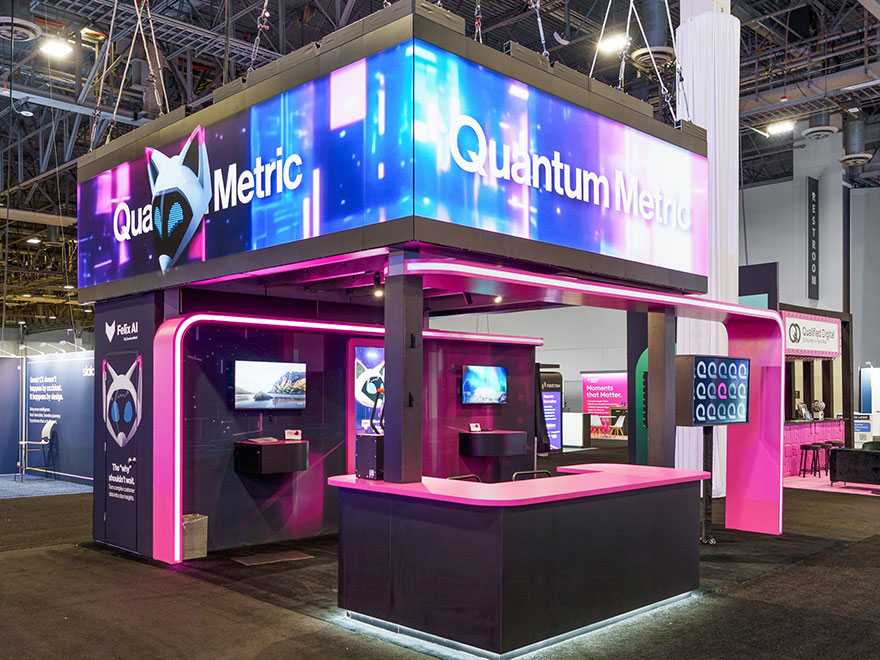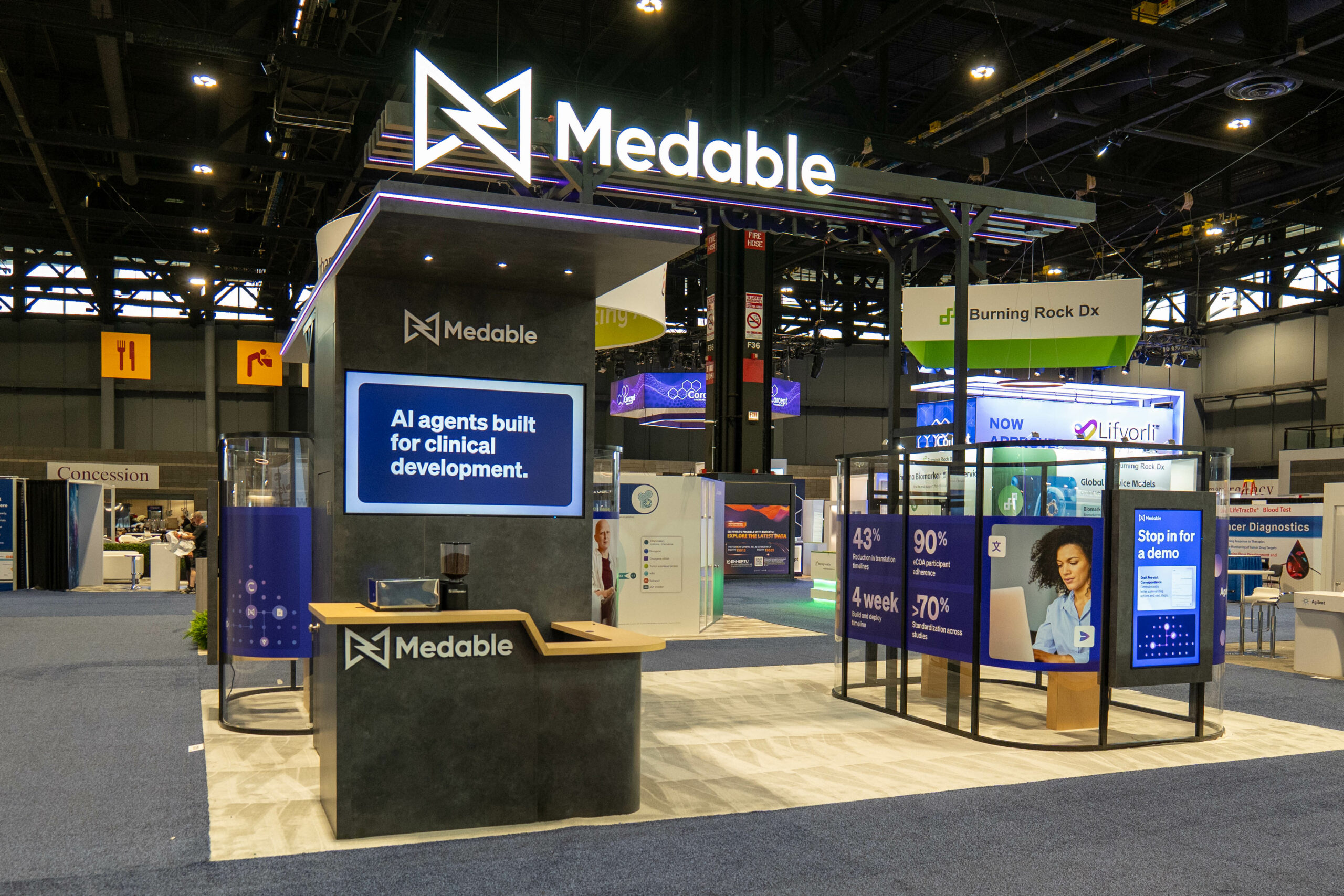
For years, trade show booth design followed a predictable pattern. Teams added more screens, more messaging, and more technology in an effort to stand out. At the time, that approach made sense. If attention was scarce, the instinct was to increase visibility.
Now, AI is accelerating that instinct. Teams can produce content more easily, personalize experiences more effectively, and layer technology into the marketing workflows surrounding the booth experience (McKinsey & Company). Importantly, this does not mean AI is designing the booth itself. It is influencing the inputs around it.
However, this shift is revealing something important.
More does not automatically lead to better engagement. In many cases, it creates the opposite effect.
As AI becomes more embedded in marketing, the most effective booths are not becoming more complex. Instead, they are becoming more intentional, more focused, and more human, as buyers increasingly rely on curated, zero-click information environments(Bain & Company).
This is where trade show booth design is actually changing.
Buildable Design Still Requires Human Expertise
For many exhibitors, the appeal of AI in booth design is speed. Teams can quickly generate concepts, explore visual directions, and iterate on ideas far faster than traditional workflows. In that context, AI can be genuinely useful for early-stage brainstorming and creative exploration.
However, speed can also create a false sense of readiness.
While AI tools can generate visually striking concepts and renderings, many of these ideas are not grounded in real-world constraints such as engineering, materials, attendee flow, union labor requirements, fabrication realities, or installation logistics. As a result, they often cannot be built as shown.
In practice, effective trade show booth design requires balancing creativity with feasibility. Spatial planning, structural integrity, budget, attendee behavior, and on-site execution all shape what is possible. This is why design remains a human-led discipline.
AI may accelerate ideation, but it does not replace the expertise required to turn a concept into a buildable, functional environment.
A compelling rendering is relatively easy to generate. Designing a booth that performs effectively on the show floor is far more complex.
Understanding this distinction is critical. Otherwise, teams risk optimizing for visuals instead of performance, which ultimately impacts engagement, execution, and ROI.
The Problem AI Is Exposing
Many companies position AI as a solution to engagement. Yet in reality, it is exposing a long-standing problem:information overload.
Research across digital marketing shows that overwhelming audiences with too much information reduces their ability to process and act, which in turn lowers engagement and slows decision-making (Zhong et al.).
This same dynamic also plays out on the trade show floor, directly impacting trade show booth design decisions.
Attendees move through environments filled with competing messages, limited time, and constant stimulation. As they navigate these spaces, they are not looking for more content. Instead, they are trying to quickly determine what is relevant and worth their attention.
Consequently, adding more screens, more copy, or more interactive elements does not solve the problem. It intensifies it. AI makes it easier to generate content at scale. Nevertheless, it does not make that content more meaningful.
What Actually Drives Engagement
If AI alone does not drive engagement, then what does?
Across multiple studies, a consistent pattern emerges. Experiential marketing plays a critical role in how people remember and evaluate brands. More specifically, immersive experiences lead to stronger memory formation, deeper emotional connection, and higher long-term recall (Wiedmann et al.).
In addition, face-to-face interaction remains one of the most effective ways to build trust in B2B environments. Even as digital channels expand, in-person engagement continues to influence decision-making in ways that passive exposure cannot (Roghanizad & Bohns).
Taken together, these findings point to a clear conclusion.
People do not remember booths. They remember experiences.
AI does not replace this reality. Instead, it raises expectations for it.
How AI Is Actually Changing Booth Design
To understand the shift more clearly, it helps to separate what AI changes from what it does not.
The Information vs. Experience Shift
AI is fundamentally changing how people access information. As content becomes instantly available through AI systems, the value of delivering information inside a booth decreases.
At the same time, the value of live, human-centered experience increases.
This creates a clear divide:
- People can access information anywhere.
- Experience can only happen in person
The most effective trade show booth design strategies center on this distinction.
AI Improves Strategy, Not Human-Centered Design
Rather than replacing human interaction, AI is changing how teams plan and execute exhibits around the booth. The change is less about visibility and more about precision.
First, AI is strengthening pre-show strategy. Teams now have better access to data, which allows them to refine targeting and prioritize the right audiences. However, this informs design decisions rather than replacing the human-led design process.
In practice, teams translate audience insights into spatial decisions. For example, when teams want to create deeper conversations instead of quick interactions, they design layouts that support smaller group settings, increase dwell time, and create separation from the show floor. Teams use seating as a strategic element rather than a purely functional one, and they reduce visual noise so attendees focus on conversation instead of content consumption.
Designing for Engagement Instead of Information Delivery
Second, booth environments are becoming more focused and intentional. Instead of trying to communicate everything at once, stronger exhibits guide attendees through a clear and intentional journey. This includes simplifying messaging, structuring the flow of the space, and creating distinct moments for interaction.
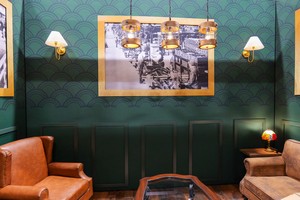
For example, at NADA 2026, the design team created a speakeasy-inspired booth for a Warranty Processing Company instead of relying on traditional product displays. Rather than presenting information through static panels or spec sheets, the team guided visitors into small, semi-private seating areas where monitors supported deeper conversations around key services.
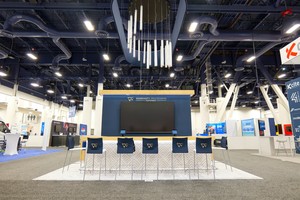
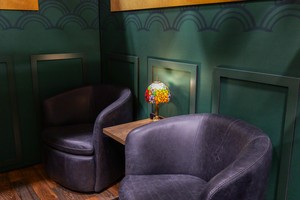
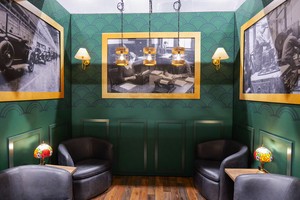
At the front of the booth, a bar area encouraged participation through trivia games on iPads, with a live leaderboard displayed on a large screen. This created a natural reason for attendees to stop, engage, and stay longer. Meanwhile, design decisions such as cushioned bench seating and frosted divider panels increased comfort and privacy, making it easier for meaningful conversations to happen.
In the speakeasy area, every detail, from the lighting to the wall decor, reinforced the immersive environment, creating a distinct shift from the noise of the show floor into a more focused, memorable experience.
AI Works Best Behind the Scenes
Finally, AI is increasingly operating behind the scenes. Its most effective applications are often invisible to the attendee. For example, it can support lead prioritization, enable more relevant follow-up, and provide insights into engagement patterns, including real-time behavior tracking and adaptive engagement strategies (Event Marketer). When used well, it enhances the experience around the booth without becoming the focal point or replacing the design itself.
The New Standard for High-Performing Exhibits
To make this actionable, it helps to frame the shift more concretely.
The Experience-First Design Model
High-performing trade show booth design is no longer centered on information delivery. Instead, they follow an experience-first model built on three principles:
- Attention is guided, not captured— the space directs focus rather than competing for it.
- Interaction creates value— attendees engage physically or conversationally, not just visually.
- Memory is the outcome— the goal is not exposure, but recall.
These principles reflect how people actually process environments, particularly in high-stimulation settings like trade shows.
As AI becomes more common, it no longer serves as a differentiator on its own. Instead, the advantage comes from how well the entire experience is designed.
High-performing trade show exhibits are built around clarity rather than volume. They prioritize experience over information and create a sense of flow rather than fragmentation. Most importantly, they support human interaction with technology instead of trying to replace it, aligning with research showing that tactile interaction increases perceived ownership and decision confidence (Peck & Shu).
This requires alignment across multiple functions. Strategy, design, operations, and follow-up must work together as part of a single system. Disconnecting these elements increases friction and weakens performance.
Where Many Exhibits Fall Short
Although many organizations are investing in AI tools, results remain inconsistent, even as adoption continues to grow across industries (Event Marketer).
In most cases, the issue is not the technology itself, but how teams apply it. Teams often separate strategy from design, which creates environments that feel disjointed. They prioritize features over experiences and treat follow-up as an afterthought instead of an extension of the initial interaction.
As a result, each stage of the exhibiting process introduces friction. Over time, that friction reduces the overall return on investment.
What This Means for Your Next Exhibit
The conversation is no longer about whether to use AI in a trade show booth.
A more useful question is how every part of the experience works together.
This includes guiding attendee movement through the space, shaping conversations, controlling information delivery, and nurturing leads after the event. Each of these elements influences the others.
AI can support this system. However, it cannot replace the need for a cohesive strategy, particularly as experiential marketing continues to outperform passive channels in building trust and long-term brand perception (Freeman).
How Teams Are Redefining Trade Show Exhibit Design
This is where exhibit design is evolving.
Rather than focusing solely on building physical spaces, leading teams are designing integrated exhibiting systems. These systems connect pre-show planning, on-site experience, and post-show follow-up into a unified approach.
More mature exhibiting programs also recognize that not every event serves the same purpose. As a result, they design systems that can scale up or down depending on the audience, objectives, and strategic importance of a specific show. In practice, this allows teams to maintain consistency across their exhibiting program while adapting the experience to fit different event priorities.
At Absolute Exhibits, we design exhibits as connected systems rather than standalone structures. We align strategy, spatial design, and execution from the beginning so every decision, from layout to materials to interaction points, supports a defined outcome.
This includes aligning pre-show targeting with the on-site experience, designing environments that naturally guide attendee behavior, and connecting on-floor engagement directly to lead capture and post-show follow-up. The result is not just a well-designed booth, but a cohesive experience that performs across the full lifecycle of the exhibit.
Ultimately, the most effective exhibits guide attention, facilitate interaction, and create meaningful experiences rather than relying on how much technology they include.
FAQ
How is AI changing trade show booth design?
AI is improving targeting, personalization, and follow-up processes. At the same time, it is pushing exhibitors to focus on more intentional, experience-driven design rather than adding more content or technology.
Does AI improve trade show ROI?
AI can improve ROI when it is integrated into a broader strategy that includes booth design, lead capture, and follow-up. This becomes even more critical when you consider how AI impacts the full operational lifecycle of an exhibit, from logistics to lead management and post-show execution, as explored inHow AI Is Transforming Exhibit Management and Trade Show Operations. On its own, however, it does not guarantee better results.
What makes a trade show booth effective today?
Effective trade show booth design prioritizes clarity, flow, and human interaction. It is designed around a specific audience and a defined experience rather than trying to communicate everything at once.
Is experiential marketing more effective than traditional booth design?
Research shows that experiential marketing improves memory, engagement, and brand perception. This makes it more effective than passive or information-heavy booth designs.
Can AI tools guarantee a buildable trade show booth design?
AI tools can be useful for brainstorming concepts, exploring visual directions, and accelerating early-stage ideation. However, effective trade show booth design requires much more than generating compelling renderings. Factors such as attendee flow, engineering, fabrication, installation logistics, budget, and real-world functionality all influence whether a booth will perform successfully on the show floor.
The most effective approach is to use AI as a support tool within a human-led design process rather than relying on it to replace strategic exhibit design expertise.
How do you know if a trade show booth design is actually buildable?
A rendering alone does not guarantee that a booth can be fabricated, transported, installed, or safely executed on the show floor. Buildable trade show booth design requires consideration of engineering, material limitations, venue regulations, installation logistics, attendee flow, and budget constraints.
Experienced exhibit teams evaluate these factors throughout the design process to ensure the final concept performs both visually and operationally in a real event environment.
Why doesn’t a good rendering always translate into a good trade show booth?
A visually impressive rendering does not automatically create an effective exhibit experience. Successful trade show booth design must account for how attendees move through the space, where conversations happen, how information is delivered, and whether the environment supports engagement rather than distraction.
In many cases, designs that look impressive in a rendering can create operational challenges or poor attendee experiences once built on the show floor. Effective exhibits balance visual impact with functionality, comfort, interaction, and execution realities.
How should companies use AI in trade shows?
AI should be used to support the experience rather than dominate it. This includes pre-show targeting, real-time insights, and post-show follow-up. It should not replace the core design process, which remains a human-led discipline grounded in spatial, experiential, and brand strategy.
What is the biggest mistake exhibitors make with AI?
The most common mistake is adding AI-driven features without aligning them to a clear strategy or attendee experience. This increases complexity without improving outcomes.
Sources and Research References
- Zhong, Y. et al. (2025).Information Overload in Digital Tourism Marketing: Challenges and Opportunities for Enhancing Purchase Intentions.
- Wiedmann, K.-P. et al. (2013).The Power of Experiential Marketing.
- Roghanizad, M., & Bohns, V. (2017).Ask in Person: You’re Less Persuasive Than You Think Over Email. Journal of Experimental Social Psychology.
- McKinsey & Company (2025).Agents for Growth: Turning AI Promise into Impact.
- Bain & Company (2025).Goodbye Clicks, Hello AI: Zero-Click Search Redefines Marketing.
- Peck, J., & Shu, S. B. (2009).The Effect of Mere Touch on Perceived Ownership. Journal of Consumer Research.
- Event Marketer (2025).From Chatbots to Agents and Beyond: How AI is Transforming Trade Shows.
- Freeman (2025).Unpacking XLNC: The Future of Commerce for Trade Shows and Conferences.