Should you rent or buy a trade show exhibit? The right answer depends on how often you exhibit, whether your booth size stays consistent, where your shows take place, and how much your internal team wants to manage after the show ends.
In the U.S., this decision is usually framed as whether to rent or buy a trade show booth or trade show exhibit. In Europe, companies often ask the same question about renting or buying an exhibition stand. The terminology may change by region, but the core decision is the same: do you need flexibility, or do you need long-term consistency?
Renting is often the better fit when your program is changing, your team is testing new markets, or your booth size shifts from show to show. Buying can make sense when you exhibit repeatedly with the same footprint, the same brand environment, and a clear plan for storage, refurbishment, shipping, and reuse.
Quick Answer: Should You Rent or Buy?
Rent a trade show exhibit if:
- Your booth size changes by show.
- You are testing a new event, product, market, or region.
- You exhibit in both the U.S. and Europe.
- You want a lower upfront investment.
- You do not want to manage storage, repairs, freight, and refurbishment.
- Your graphics, messaging, or product focus changes often.
- Your event or marketing team has limited time to manage exhibit assets.
Buy a trade show exhibit if:
- You only exhibit once or twice per year.
- Your booth footprint stays consistent.
- Your brand environment needs to look the same at every event.
- You can reuse the structure over multiple years.
- You have budget for storage, repairs, graphics, freight, and installation.
- You have an exhibit management process or an exhibit partner who can manage the asset for you.
The short version: rent for flexibility and lower upfront risk. Buy for consistency and repeated use. Either way, compare the total cost of the program, not just the first-show cost.
Renting vs. Buying a Trade Show Exhibit: Side-by-Side Comparison
| Factor | Renting | Buying |
| Upfront cost | Lower initial investment | Higher initial investment |
| Long-term cost | Repeated rental cost | Can be efficient with enough reuse |
| Flexibility | Easier to change size, layout, and graphics | Better for consistent programs |
| Customization | Customizable within rental or custom rental options | Highest control over owned structure |
| Storage | Usually no long-term storage burden | Requires storage and asset management |
| Shipping | Often simpler when managed by an exhibit partner | Owned properties must be shipped, tracked, and returned |
| Refurbishment | Less long-term upkeep | Repairs and refreshes are part of ownership |
| Best For | Changing programs, first-time exhibitors, international shows | Exhibitors with stable booth needs |
When Renting a Trade Show Exhibit Makes More Sense
Renting a trade show exhibit is usually the better option when your exhibit program is still evolving. That may mean you are new to trade shows, entering a new market, changing booth sizes, launching different products, or exhibiting internationally.
In our experience, rental exhibits are especially useful when a company does not yet know what its long-term trade show needs will look like. A 20×20 booth may be enough for one event, while a 30×30 or double deck exhibit may make more sense for the next. Renting gives your team room to adjust without committing to a single footprint too early.
Rental also works well for short-term campaigns.
If your messaging changes often, or if one event is built around a specific product launch, a rental exhibit can be designed around the current goal without requiring the same structure to work for every future show.
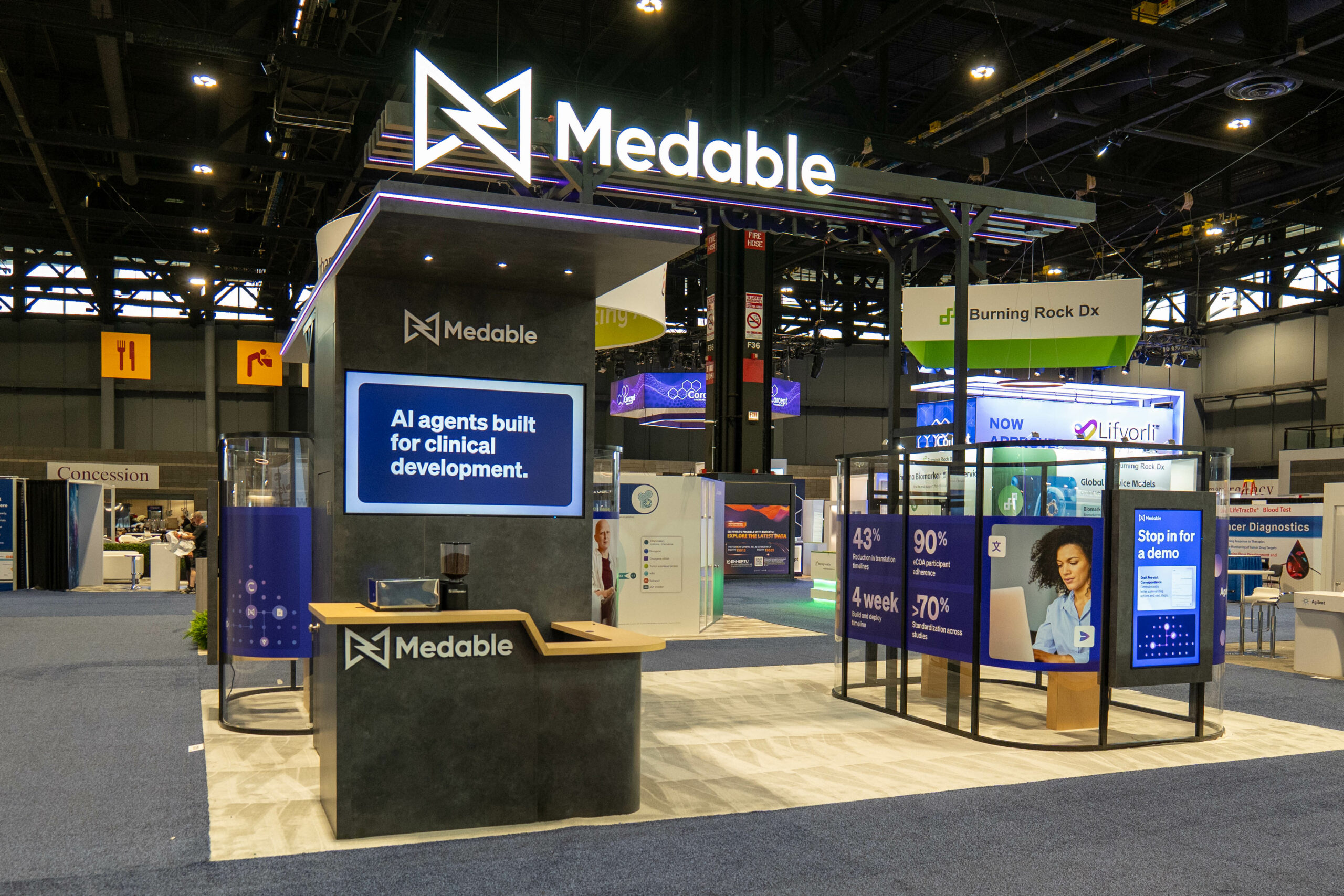
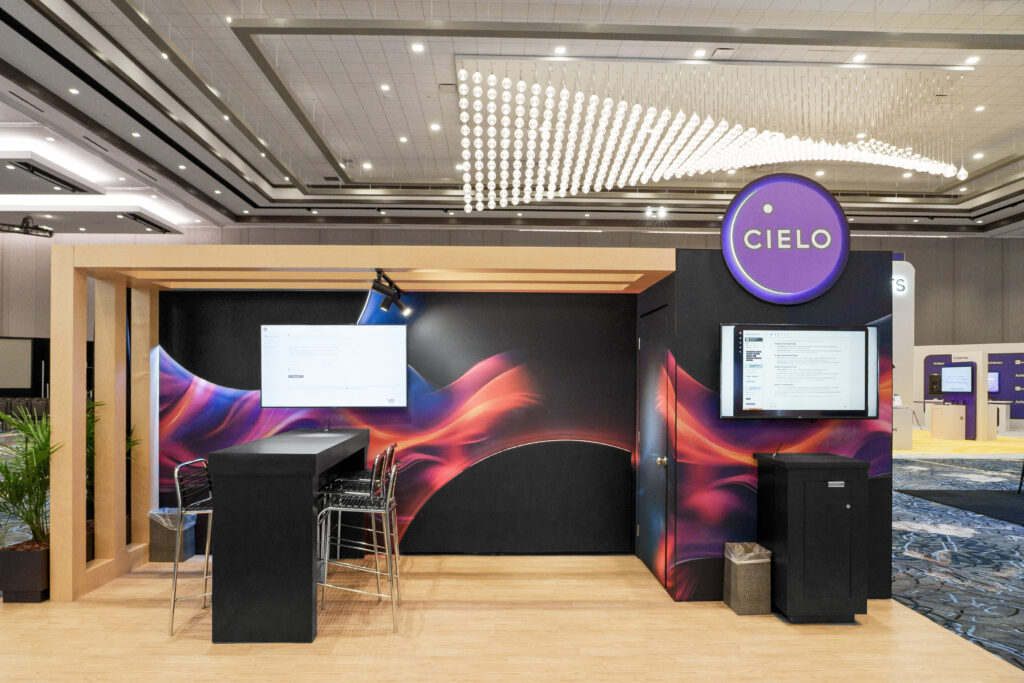
This does not mean a rental exhibit has to look generic. A strong [trade show exhibit rental] can still include custom graphics, branded finishes, product displays, lighting, meeting rooms, demo areas, and architectural details. With the right design, many attendees will not know whether the booth is rented or owned.
Renting can also reduce the operational burden on lean marketing teams.
Owned exhibits need to be stored, inspected, repaired, refreshed, shipped, received, installed, dismantled, and returned. If your team is already managing campaigns, sales enablement, show planning, lead capture, travel, and follow-up, removing some of that exhibit asset management can make a real difference.
Rental may be the smarter choice if you:
- Are exhibiting for the first time.
- Going to try a new industry event.
- Will enter a new geographic market.
- Have a booth size that changes throughout the year.
- Require regular changes with product or campaign messaging.
- Have overlapping show schedules.
- Need a U.S. booth and a European exhibition stand.
- Or your internal team does not have time to manage exhibit ownership.
Shipping to different continents is complicated. For international exhibitors, rental can be especially practical. A company based in Europe may not want to ship an owned stand to the U.S. for one or two shows, and the same is true for a U.S. company exhibiting in Europe. In those cases, renting or producing regionally can simplify the program.
When Buying a Trade Show Exhibit Makes More Sense
Buying a trade show exhibit can make sense when your exhibit program is stable and repeatable.
If your company attends the same flagship industry events every year, uses the same booth size, and wants the same brand environment from show to show, ownership can give you more control. Instead of redesigning the exhibit each time, you can build around a consistent structure and update the graphics, product displays, or smaller details as needed.
Ownership is often easier to justify when the exhibit is part of a multi-year program.
For example, a company that uses the same 20×30 or 30×30 booth several times a year may eventually reach a point where buying supports the long-term plan. The key is that the structure needs to be reused enough to justify the additional responsibilities that come with ownership.
Buying may also be a fit for product-heavy exhibits. If your booth includes custom product walls, complex demo stations, specialty lighting, integrated technology, or structural elements designed around a specific product line, ownership can give you more control over the environment.
The tradeoff is that ownership does not end when the show closes.
Owned exhibits need a plan. They need storage, repairs, refurbishment, graphics updates, freight coordination, material handling, installation and dismantle, inventory tracking, and eventual replacement or disposal.
Buying may be the better choice if you:
- Exhibit several times per year.
- Have a booth footprint that stays consistent.
- Attend the same major industry events every year.
- Need a brand environment that needs to look consistent across shows.
- Require product-specific or highly customized components.
- Regularly have a multi-year exhibit program.
- Have an internal team or exhibit management partner who can manage the asset.
Buying is not automatically better or worse than renting. It is simply a better fit for programs that are consistent enough to make ownership worthwhile.
What Costs Should You Compare Before Deciding?
The biggest mistake buyers make is comparing only the rental price against the purchase price. That first number rarely tells the whole story.
Before deciding whether to rent or buy a trade show exhibit, compare the full program cost across multiple shows. Include the visible costs, but also include the costs that happen before and after each event.
Costs to compare include:
- Design
- Fabrication
- Graphics
- Crating
- Storage
- Pulling and prep
- Freight
- Material handling
- Installation and dismantle
- Repairs
- Refurbishment
- Reconfiguration
- Disposal or replacement
Material handling is one cost that often surprises exhibitors, especially in the U.S. It is not the same as shipping. Shipping gets your exhibit to the venue, advance warehouse, or show site. Material handling, often called drayage, covers the movement of exhibit materials from the loading dock or warehouse to the booth, storage of empty crates during the event, and movement back for outbound pickup after the show.
That distinction matters because shipping an owned exhibit to the show is only one part of the logistics cost. Once it arrives, the exhibit still needs to move through the official show process.
If you buy an exhibit, also think about what happens between shows. Who checks the crates when they return? What about which graphics need to be replaced? Or tracks damaged pieces? Who decides whether the structure can be reconfigured for the next booth size? Who manages storage and outbound shipping deadlines?
Those costs and tasks do not mean ownership is a bad choice. They simply need to be included in the decision.
Your accounting or finance team may also treat owned exhibit assets differently than rentals. Before deciding, ask them how they want to evaluate the purchase, rental, depreciation, and expense treatment for your company.
How U.S. and European Trade Shows Change the Decision
The rent-versus-buy decision can change depending on where you exhibit.
In the U.S., trade show programs often require close attention to material handling, union labor, show services, installation and dismantle, freight, advance warehouse deadlines, and venue-specific rules. Even if you own the booth, you still need to manage the logistics required to get it to the show floor and back.
In Europe, buyers may use different terminology. Instead of “trade show booth,” you may hear “exhibition stand.” Instead of “booth builder,” buyers may search for an exhibition stand contractor, stand builder, exhibition stand rental, or custom exhibition stand. Depending on the show and venue, certain services may be bundled differently than they are in the U.S.
International exhibiting adds another layer. Shipping an owned exhibit across borders can involve customs documents, temporary import procedures, duties, taxes, deposits, or re-export requirements. ATA Carnets may be used for goods intended for trade shows and exhibitions, but they do not apply to consumable or disposable items. In the EU, temporary admission can apply to goods brought in for display or use at exhibitions, fairs, meetings, or similar events, but it may require security or duty paid on deposit.
That is why regional rental or regional production can sometimes be more practical than moving an owned exhibit across continents. If you exhibit regularly in both the U.S. and Europe, the best solution may not be one booth traveling everywhere. It may be a coordinated program with regional exhibit assets, regional production, or rental structures adapted to each market.
For companies with international programs, the question is not only “Should we rent or buy?” It is also “Where should this exhibit be built, stored, shipped from, and managed?”
Questions to Ask Before You Rent or Buy
Before making the decision, walk through these questions with your team:
- How many shows will we attend this year?
- How many shows will we attend over the next two to five years?
- Will the booth footprint stay the same?
- Are we exhibiting in one region or multiple regions?
- Do we need the same booth design every time?
- How often do our graphics or messaging change?
- Are we testing a market or investing in a long-term exhibit program?
- Do we need a custom trade show exhibit, or would a custom rental accomplish the same goal?
- Who will manage storage, freight, refurbishment, and installation?
- What happens if the booth size changes next year?
- What is the true cost per show after storage, freight, labor, repairs, and graphics?
- Do we have an internal process for exhibit asset management?
- Would regional rental or production be more efficient for international shows?
The answers should point you toward the right model. A first-time exhibitor testing a new event will usually have different needs than a company with a mature multi-show program. A U.S.-only program will have different logistics than a company exhibiting across North America and Europe.
The Bottom Line
Renting a trade show exhibit is usually the better fit for flexibility, changing booth sizes, new markets, international programs, and lower upfront risk. It can also reduce the amount of storage, refurbishment, freight, and asset management your team needs to handle between shows.
Buying a trade show exhibit can make sense when your company exhibits repeatedly with the same footprint, uses a consistent brand environment, and has a clear plan for reuse. Ownership can support long-term efficiency, but only when the exhibit is used enough to justify the storage, repairs, refurbishment, shipping, and management behind it.
The best decision comes from comparing total cost and operational impact, not just the first quote.
Need help deciding whether to rent or buy? Talk with Absolute Exhibits about your show schedule, booth size, and exhibit goals. We can help you compare rental, purchase, and custom exhibit options based on how your program actually works.
FAQ
Is it cheaper to rent or buy a trade show exhibit?
Renting usually costs less upfront, but buying can lower the cost per show if the exhibit is reused often enough. The real comparison should include storage, freight, repairs, refurbishment, graphics, material handling, and labor.
How many shows justify buying a trade show booth?
There is no universal number. Buying becomes easier to justify when the booth size, branding, layout, and exhibit goals stay consistent across multiple shows. If the exhibit needs to change often, rental may still be the better option.
Can a rental trade show exhibit look custom?
Yes. Rental exhibits can include custom graphics, finishes, meeting rooms, product displays, lighting, demo areas, and branded architectural details. A rental structure does not have to look generic when the design is handled well.
Is renting better for international exhibitors?
Often, yes. Renting or producing regionally can reduce the need to ship owned exhibit properties across countries or continents. This can be especially useful for companies exhibiting in both the U.S. and Europe.
What is the biggest hidden cost of buying an exhibit?
Storage, refurbishment, freight, material handling, and labor are often underestimated. These costs continue after the first show, so they should be included when comparing ownership against rental.